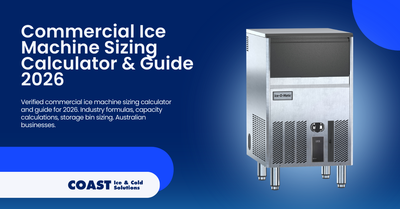
Commercial Ice Machine Sizing Calculator & Guide 2026
The Coast Team on 5th Feb 2026
Choosing the right size commercial ice machine is critical to your operation's success. An undersized machine causes constant ice shortages, customer dissatisfaction, and lost revenue. An oversized machine wastes capital, increases operating costs, and reduces efficiency.
This sizing calculator and guide covers what Australian businesses need to know about sizing commercial ice machines in 2026. Topics include industry-specific sizing formulas (based on common industry benchmarks), capacity calculations, storage bin sizing, peak demand planning, and real-world examples.
Production capacity ratings in this guide are drawn from manufacturer specifications. Actual output varies with ambient temperature, water temperature, water quality, and maintenance. Always verify model-specific production figures in the manufacturer manual for your unit.
Download manuals from Coast Distributors' manuals page.
Coast Distributors is the Australian exclusive importer of Ice-O-Matic, Follett, Grant, and Lassele. Contact us for sizing and product enquiries.
Table of Contents
- Why Proper Sizing Matters
- Understanding Ice Production Capacity
- Industry-Specific Sizing Formulas
- Restaurant Sizing Guide
- Bar/Pub Sizing Guide
- Hotel Sizing Guide
- Healthcare Sizing Guide
- Seafood/Food Display Sizing
- Peak Demand Calculations
- Storage Bin Sizing
- Sizing Calculator Examples
- Real-World Sizing Examples
- Common Sizing Mistakes
- Sizing by Machine Type
- FAQ Section
- Conclusion
Why Proper Sizing Matters
Proper sizing is critical. Make informed decisions.
Consequences of Undersizing
Operational Problems
- Constant ice shortages
- Customer dissatisfaction
- Lost revenue opportunities
- Staff frustration
- Emergency ice purchases
Cost Implications
- Emergency ice costs (typically $5–10/kg; costs are indicative—contact us for current pricing)
- Lost sales
- Customer complaints
- Reputation damage
- Equipment replacement costs
Consequences of Oversizing
Waste Problems
- Wasted capital investment
- Higher energy consumption
- Increased operating costs
- Unnecessary space usage
- Reduced efficiency
Operational Issues
- Ice sitting too long
- Quality degradation
- Storage capacity waste
- Higher maintenance costs
- Reduced ROI
Benefits of Proper Sizing
Optimal Performance
- Meets demand consistently
- Efficient operation
- Cost-effective
- Reliable service
- Customer satisfaction
Financial Benefits
- Right-sized investment
- Optimal operating costs
- Maximum ROI
- Efficient energy use
- Lower total cost of ownership
Coast Distributors: Contact us for sizing and product enquiries.
Understanding Ice Production Capacity
How ice production capacity is measured and what affects it.
Production Capacity Ratings
Standard Conditions (ANSI/HARDI)
- Production rated at 21°C (70°F) ambient, 10°C (50°F) inlet water
- 24-hour continuous operation under test conditions
- Ideal conditions; actual production varies by site
Australian Conditions
- Summer ambient often exceeds 32°C; rated performance assumes max 32°C for air-cooled units
- Production is typically 10-20% lower in summer
- Water temperature and quality vary by region (hard water in Adelaide, Perth, and many regional areas affects output)
- Always size for peak demand and local conditions
Always account for Australian conditions when sizing. Manufacturer ratings are based on standard test conditions. Verify specifications in your model's installation or specification sheet. Download from Coast Distributors' manuals page.
Note: Production capacity varies by brand and model. Ice-O-Matic, Follett, Grant, and Lassele models have different performance characteristics. Check model-specific specifications. Contact us for sizing and product enquiries.
Factors Affecting Production
Ambient Temperature
- Production drops 10-15% per 5°C above 32°C
- Summer performance lower
- Consider water-cooled for hot climates
- Account for peak summer demand
Water Temperature
- Cooler water improves production
- Warmer water reduces production
- Water temperature varies by location
- Consider water source temperature
Water Quality
- Hard water reduces efficiency
- Scale buildup decreases production
- Filtration essential (CD20B, CD40B, CD500B—Lassele LUI series may specify CD10B; check your model’s product page or manual)
- Water treatment required in some areas
Maintenance
- Clean machines produce more
- Scale reduces production
- Regular maintenance critical
- Filter condition affects production
Production Capacity by Machine Type
Self-Contained Units
- Range: 20-130kg/day typically
- Examples: Ice-O-Matic UCG085A (38.5kg), Lassele LUI-250A (126kg)
Modular Units
- Range: 130-800kg+/day
- Examples: Ice-O-Matic CIM0825 (408kg), Ice-O-Matic CIM1545 (708kg)
Nugget/Chewblet
- Range: 45-300kg+/day
- Examples: Follett E7CI114A (45.4kg), Follett MCE414ABT (193kg)
Flake Ice
- Range: 200-1,000kg+/day
- Examples: Grant PB0.3F-FZ/Y (300kg), Ice-O-Matic MFI1255A (572kg)
Coast Distributors: Contact us for sizing and product enquiries.
Industry-Specific Sizing Formulas
Industry-specific formulas help calculate your ice requirements accurately.
General Sizing Formula
Basic Calculation:
Daily Ice Need = (Number of Units) × (Ice per Unit) × (Peak Factor)
Where:
- Number of Units = Customers, rooms, beds, etc.
- Ice per Unit = Industry benchmark (see below)
- Peak Factor = 1.2-1.3 (20-30% buffer)
Example:
- 200-seat restaurant
- 0.7kg per customer
- 1.25 peak factor
- Calculation: 200 × 0.7 × 1.25 = 175kg/day
Industry Benchmarks
|
Industry |
Ice per Unit |
Peak Factor |
Notes |
|
Cafe |
0.5kg per customer |
1.2 |
Lower ice usage |
|
Restaurant |
0.7kg per customer |
1.25 |
Standard dining |
|
Bar/Pub |
1.4kg per customer |
1.3 |
High ice usage |
|
Hotel |
2.3kg per room |
1.2 |
Room service, bars |
|
Hospital |
4.5kg per bed |
1.2 |
Patient care, foodservice |
|
Fast Food |
0.4kg per customer |
1.2 |
Quick service |
|
Seafood Display |
5-10kg per display |
1.3 |
Continuous refresh |
|
Food Processing |
10-20kg per 100kg product |
1.2 |
Processing needs |
Note: These are industry benchmarks used for estimation. Actual requirements vary by operation style, menu, climate, and service patterns. Verify against your own usage or consult Coast Distributors for sizing.
Peak Demand Considerations
Peak Periods:
- Friday/Saturday nights (bars, restaurants)
- Summer months (all venues)
- Special events
- Holiday periods
- Lunch/dinner rushes
Peak Factor:
- Add 20-30% buffer typically
- Higher for venues with extreme peaks
- Account for seasonal variations
- Consider event capacity
Australian Considerations:
- Summer demand higher
- Hot weather increases usage
- Outdoor events increase demand
- Account for climate
Restaurant Sizing Guide
Restaurant ice requirements vary by service style and capacity.
Restaurant Sizing Formula
Standard Restaurant:
Daily Ice = (Seats) × (Turns per Day) × 0.7kg × 1.25
Where:
- Seats = Restaurant capacity
- Turns = Average table turns per day
- 0.7kg = Ice per customer
- 1.25 = Peak factor (25% buffer)
Example Calculation:
- 150-seat restaurant
- 2 turns per day (lunch + dinner)
- 300 customers daily
- Calculation: 300 × 0.7 × 1.25 = 262kg/day
Recommended Machine:
- Ice-O-Matic CIM0635 (259kg/day) - Close match
- Ice-O-Matic CIM0825 (408kg/day) - Extra capacity
Fine Dining Sizing
Fine Dining Considerations:
- Higher ice usage (cocktails, wine service)
- Premium ice types (gourmet, large cube)
- Extended service hours
- Higher peak factor
Formula:
Daily Ice = (Seats) × (Turns) × 1.0kg × 1.3
Example:
- 80-seat fine dining
- 1.5 turns per day
- 120 customers daily
- Calculation: 120 × 1.0 × 1.3 = 156kg/day
Recommended Machine:
- Ice-O-Matic CIM0435 (218kg/day) with gourmet ice option
- For smaller fine-dining venues, undercounter options such as Ice-O-Matic UCG105A (47.5kg/day) suit backup or low-volume bars only; for 156kg/day, use modular or higher-capacity self-contained units.
Quick Service Sizing
Quick Service Considerations:
- Lower ice usage per customer
- High customer volume
- Fast turnover
- Standard ice types
Formula:
Daily Ice = (Customers per Day) × 0.4kg × 1.2
Example:
- 500 customers per day
- Calculation: 500 × 0.4 × 1.2 = 240kg/day
Recommended Machine:
- Ice-O-Matic CIM0525 (237kg/day) - Good match
- Ice-O-Matic CIM0635 (259kg/day) - Extra capacity
Restaurant Storage Bin Sizing
Storage Requirements:
- 50-100% of daily production
- Higher for peak periods
- Account for service patterns
- Consider backup capacity
Recommended Storage:
Bar/Pub Sizing Guide
Bars and pubs have the highest ice requirements per customer.
Bar Sizing Formula
Standard Bar:
Daily Ice = (Bar Seats) × (Turns) × 1.4kg × 1.3
Where:
- Bar Seats = Bar capacity
- Turns = Customer turns per day
- 1.4kg = Ice per customer (highest usage)
- 1.3 = Peak factor (30% buffer for Friday/Saturday)
Example Calculation:
- 100-seat bar
- 3 turns per day
- 300 customers daily
- Calculation: 300 × 1.4 × 1.3 = 546kg/day
Recommended Machine:
- Ice-O-Matic CIM1135 (425kg/day) - May be tight
- Ice-O-Matic CIM1545 (708kg/day) - Better capacity
- Consider dual-head system for peak periods
Cocktail Bar Sizing
Cocktail Bar Considerations:
- Premium ice types (gourmet, large cube)
- Higher ice usage per drink
- Extended hours
- Peak weekend demand
Formula:
Daily Ice = (Bar Seats) × (Turns) × 1.6kg × 1.3
Example:
- 60-seat cocktail bar
- 4 turns per day
- 240 customers daily
- Calculation: 240 × 1.6 × 1.3 = 499kg/day
Recommended Machine:
- Ice-O-Matic CIM1135 (425kg/day) - Close
- Ice-O-Matic CIM1545 (708kg/day) - Extra capacity
- Consider gourmet ice machines: UCG105A or UCG135A for premium ice
Pub Sizing
Pub Considerations:
- High customer volume
- Extended hours
- Weekend peaks
- Multiple service areas
Formula:
Daily Ice = (Pub Capacity) × (Turns) × 1.4kg × 1.3
Example:
- 200-person pub
- 2.5 turns per day
- 500 customers daily
- Calculation: 500 × 1.4 × 1.3 = 910kg/day
Recommended Machine:
- Ice-O-Matic CIM1845 (776kg/day) - May need dual system
- Consider dual-head configuration
- Or multiple machines for different areas
Bar Storage Bin Sizing
Storage Requirements:
- 75-100% of daily production
- Higher for weekend peaks
- Multiple service points
- Backup capacity essential
Recommended Storage:
Hotel Sizing Guide
Hotel ice requirements include guest rooms, restaurants, bars, and room service.
Hotel Sizing Formula
Standard Hotel:
Daily Ice = (Rooms) × 2.3kg × 1.2
Where:
- Rooms = Number of guest rooms
- 2.3kg = Ice per room (room service, bars, restaurants)
- 1.2 = Peak factor (20% buffer)
Example Calculation:
- 200-room hotel
- Calculation: 200 × 2.3 × 1.2 = 552kg/day
Recommended Machine:
- Ice-O-Matic CIM1135 (425kg/day) - May be tight
- Ice-O-Matic CIM1545 (708kg/day) - Better capacity
Hotel with Multiple Outlets
Complex Hotel Formula:
Daily Ice = (Room Ice) + (Restaurant Ice) + (Bar Ice) + (Banquet Ice)
Where:
- Room Ice = Rooms × 1.5kg
- Restaurant Ice = Restaurant seats × 0.7kg × turns
- Bar Ice = Bar seats × 1.4kg × turns
- Banquet Ice = Banquet capacity × 0.5kg × events
Example:
- 300-room hotel
- 150-seat restaurant (2 turns)
- 80-seat bar (3 turns)
- 500-person banquet capacity (0.5 events/day)
Calculation:
- Room Ice: 300 × 1.5 = 450kg
- Restaurant: 150 × 0.7 × 2 = 210kg
- Bar: 80 × 1.4 × 3 = 336kg
- Banquet: 500 × 0.5 × 0.5 = 125kg
- Total: 1,121kg/day
Recommended Machine:
- Dual Ice-O-Matic CIM1545 (1,416kg total)
- Or Ice-O-Matic CIM1845 (776kg) + CIM1135 (425kg)
Hotel Storage Bin Sizing
Storage Requirements:
- 50-75% of daily production
- Multiple service points
- Room service capacity
- Backup for events
Recommended Storage:
- Small hotels: B55 (232kg) or B110 (388kg)
- Medium hotels: B110 (388kg) or multiple bins
- Large hotels: Multiple B110 bins or larger systems
Healthcare Sizing Guide
Healthcare facilities have unique ice requirements for patient care and foodservice.
Healthcare Sizing Formula
Standard Healthcare:
Daily Ice = (Beds) × 4.5kg × 1.2
Where:
- Beds = Number of patient beds
- 4.5kg = Ice per bed (patient care, foodservice, hydration)
- 1.2 = Peak factor (20% buffer)
Example Calculation:
- 150-bed hospital
- Calculation: 150 × 4.5 × 1.2 = 810kg/day
Recommended Machine:
- Ice-O-Matic CIM1545 (708kg/day) - May be tight
- Ice-O-Matic CIM1845 (776kg/day) - Better
- Consider dual-head system for larger facilities
Healthcare with Nugget Ice
Nugget Ice Considerations:
- Patient-safe (no choking hazard)
- Preferred for healthcare
- Softer, easier to consume
- Better for hydration
Recommended Machines:
- Follett E7CI114A (45.4kg/day) - Small facilities
- Follett E15CI114A (45.4kg/day) - Countertop units
- Follett MCE414ABT (193kg/day) - Medium facilities
- Follett E12CI414A-S (176kg/day) - Countertop systems
Sizing:
- Small units: 1-2 units per nursing station
- Medium facilities: Centralized system
- Large facilities: Multiple systems
Aged Care Sizing
Aged Care Considerations:
- Lower ice usage per resident
- Nugget ice preferred
- Foodservice needs
- Hydration support
Formula:
Daily Ice = (Residents) × 2.0kg × 1.2
Example:
- 100-resident facility
- Calculation: 100 × 2.0 × 1.2 = 240kg/day
Recommended Machine:
- Follett MCE414ABT (193kg/day) - May need multiple
- Or Ice-O-Matic CIM0525 (237kg/day) for cube ice
Seafood/Food Display Sizing
Seafood and food displays require continuous ice refreshment.
Seafood Display Sizing
Display Sizing Formula:
Daily Ice = (Display Size) × (Refresh Rate) × (Days)
Where:
- Display Size = kg of product on display
- Refresh Rate = 5-10kg ice per kg product
- Days = Operating days
Example:
- 50kg seafood display
- 7kg ice per kg product
- Calculation: 50 × 7 = 350kg/day
Recommended Machine:
- Grant PB0.3F-FZ/Y (300kg/day) - Close
- Ice-O-Matic MFI1255A (572kg/day) - Extra capacity
Food Processing Sizing
Processing Sizing Formula:
Daily Ice = (Product Weight) × (Ice Ratio) × (Processing Days)
Where:
- Product Weight = kg of product processed
- Ice Ratio = 0.1-0.2 (10-20% ice by weight)
- Processing Days = Days per week processing
Example:
- 1,000kg product per day
- 15% ice ratio
- Calculation: 1,000 × 0.15 = 150kg/day
Recommended Machine:
- Grant PB0.3F-FZ/Y (300kg/day) - Good capacity
- Ice-O-Matic MFI0805A (333kg/day) - Alternative
Peak Demand Calculations
Accounting for peak demand ensures adequate capacity during busy periods.
Peak Period Identification
Common Peak Periods:
- Friday/Saturday nights (bars, restaurants)
- Summer months (all venues)
- Lunch/dinner rushes
- Special events
- Holiday periods
Peak Factor Application
Standard Peak Factor:
- 1.2 (20% buffer) - Standard operations
- 1.25 (25% buffer) - Moderate peaks
- 1.3 (30% buffer) - Extreme peaks
When to Use Higher Factors:
- Extreme weekend peaks
- Event venues
- Seasonal variations
- Unpredictable demand
Australian Peak Considerations
Summer Demand:
- 20-30% higher in summer
- Hot weather increases usage
- Outdoor events
- Extended service hours
Weekend Peaks:
- Bars: 50-100% higher weekends
- Restaurants: 30-50% higher
- Hotels: Varies by location
- Account for local patterns
Storage Bin Sizing
Proper storage bin sizing ensures adequate ice availability.
Storage Bin Sizing Formula
Standard Storage:
Storage Capacity = (Daily Production) × (Storage Factor)
Where:
- Daily Production = Machine production capacity
- Storage Factor = 0.5-1.0 (50-100% of daily production)
Storage Factor Guidelines
Storage Factors by Application:
- Continuous service: 0.5-0.75 (50-75%)
- Peak periods: 0.75-1.0 (75-100%)
- Backup capacity: 1.0+ (100%+)
Storage Bin Options
Ice-O-Matic Storage Bins:
Storage Bin Selection:
- Match to production capacity
- Account for peak demand
- Consider service patterns
- Allow for backup capacity
Sizing Calculator Examples
Practical examples demonstrate sizing calculations.
Example 1: Medium Restaurant
Scenario:
- 120-seat restaurant
- 2.5 turns per day
- Standard dining
- Moderate peaks
Calculation:
- Customers: 120 × 2.5 = 300
- Ice need: 300 × 0.7kg = 210kg
- Peak factor: 210 × 1.25 = 262kg/day
Recommended:
- Ice-O-Matic CIM0635 (259kg/day) - Good match
- Storage: B55 (232kg)
Example 2: Large Bar
Scenario:
- 150-seat bar
- 4 turns per day
- Weekend peaks
- Extended hours
Calculation:
- Customers: 150 × 4 = 600
- Ice need: 600 × 1.4kg = 840kg
- Peak factor: 840 × 1.3 = 1,092kg/day
Recommended:
- Dual Ice-O-Matic CIM1545 (1,416kg total)
- Storage: Multiple B110 bins
Example 3: Small Hotel
Scenario:
- 80-room hotel
- Restaurant and bar
- Standard service
Calculation:
- Room ice: 80 × 2.3kg = 184kg
- Restaurant: 50 seats × 0.7kg × 2 = 70kg
- Bar: 40 seats × 1.4kg × 2 = 112kg
- Total: 366kg/day
- Peak factor: 366 × 1.2 = 439kg/day
Recommended:
- Ice-O-Matic CIM0825 (408kg/day) - Close
- Ice-O-Matic CIM1135 (425kg/day) - Better
- Storage: B110 (388kg)
Real-World Sizing Examples
Real-world examples from Australian businesses.
Case Study 1: Melbourne Restaurant
Business:
- 180-seat fine dining restaurant
- 2 turns per day
- Premium cocktails
- Weekend peaks
Sizing:
- Customers: 180 × 2 = 360
- Ice: 360 × 1.0kg = 360kg
- Peak: 360 × 1.3 = 468kg/day
Solution:
- Ice-O-Matic CIM1135 (425kg/day) + UCG105A (47.5kg gourmet) for premium drinks
- Total: 472kg/day capacity
Case Study 2: Sydney Hotel
Business:
- 250-room hotel
- Restaurant, bar, room service
- Conference facilities
Sizing:
- Room ice: 250 × 1.5 = 375kg
- Restaurant: 100 × 0.7 × 2 = 140kg
- Bar: 60 × 1.4 × 3 = 252kg
- Conference: 200 × 0.5 × 0.3 = 30kg
- Total: 797kg/day
Solution:
- Ice-O-Matic CIM1545 (708kg/day) - Close
- Consider dual system for peak periods
Common Sizing Mistakes
Avoiding common mistakes saves money and prevents problems.
Mistake 1: Not Accounting for Peaks
Problem:
- Undersized for peak periods
- Ice shortages
- Customer dissatisfaction
Solution:
- Always add peak factor
- Account for seasonal variations
- Plan for events
- Consider dual systems
Mistake 2: Ignoring Australian Conditions
Problem:
- Production lower in summer
- Hot weather reduces capacity
- Insufficient capacity
Solution:
- Account for ambient temperature
- Consider water-cooled for hot climates
- Add extra buffer for summer
- Monitor performance
Mistake 3: Underestimating Storage Needs
Problem:
- Insufficient storage
- Ice shortages during peaks
- Production does not keep up
Solution:
- Size storage 50-100% of production
- Account for peak demand
- Consider service patterns
- Allow backup capacity
Mistake 4: Not Considering Growth
Problem:
- Machine too small for growth
- Need replacement soon
- Wasted investment
Solution:
- Plan for growth
- Consider modular systems
- Allow expansion capacity
- Future-proof investment
Sizing by Machine Type
Different machine types suit different sizing requirements.
Self-Contained Units
Best For:
- Small to medium operations
- 20-130kg/day requirements
- Limited space
- Simple installation
Examples:
Modular Systems
Best For:
- Medium to large operations
- 130-800kg+/day requirements
- Scalable needs
- High capacity
Examples:
Nugget/Chewblet Systems
Best For:
- Healthcare facilities
- Aged care
- Smoothie bars
- Patient-safe applications
Examples:
Flake Ice Systems
Best For:
- Seafood displays
- Food processing
- Medical applications
- Industrial uses
Examples:
- PB0.3F-FZ/Y (300kg/day) - Seafood, processing
- MFI1255A (572kg/day) - Large displays
FAQ Section
How do I calculate what size ice machine I need?
Calculate using: (Number of Units) × (Ice per Unit) × (Peak Factor). Industry benchmarks: restaurants 0.7kg/customer, bars 1.4kg/customer, hotels 2.3kg/room, hospitals 4.5kg/bed. Add 20-30% peak factor. See our industry-specific formulas for detailed guidance.
What is the difference between production capacity and storage capacity?
Production capacity is daily ice production (kg/day). Storage capacity is how much ice the bin holds (kg). Storage should be 50-100% of daily production typically. Production determines if you meet demand. Storage provides buffer for peaks. See our storage bin sizing section.
How much ice does a restaurant need per day?
Restaurants typically need 0.7kg per customer. A 150-seat restaurant with 2 turns (300 customers) needs 210kg base, plus 25% peak factor = 262kg/day. Actual needs vary by service style, menu, and climate. See our restaurant sizing guide for detailed calculations.
Do I need a bigger machine for summer?
Yes, summer demand is typically 20-30% higher due to hot weather. Also, production capacity decreases 10-15% per 5°C above 32°C ambient temperature. Size for summer peak demand and account for reduced production in hot conditions. Consider water-cooled units for hot climates.
What size storage bin do I need?
Storage bins should hold 50-100% of daily production typically. Higher storage (75-100%) for peak periods, lower (50-75%) for continuous service. Match bin to production capacity and service patterns. See our storage bin sizing section for detailed guidance.
Can I use multiple smaller machines instead of one large machine?
Yes, multiple machines provide redundancy and flexibility. They are more efficient for distributed service points. They require more space, installation, and maintenance. Consider your specific needs, space availability, and service patterns. See our machine type guide.
How do I size an ice machine for a bar?
Bars need the highest ice usage: 1.4kg per customer. Calculate: (Bar seats) × (Turns) × 1.4kg × 1.3 peak factor. A 100-seat bar with 3 turns needs 546kg/day. Account for weekend peaks (30%+ higher). See our bar sizing guide for detailed calculations.
What happens if I undersize my ice machine?
Undersizing causes: constant ice shortages, customer dissatisfaction, lost revenue, emergency ice purchases ($5–10/kg; costs indicative—contact us for current pricing), staff frustration, and potential equipment replacement. Always add 20-30% peak factor and account for Australian conditions. See our common mistakes section.
How do I account for peak demand when sizing?
Add a peak factor (1.2-1.3 typically, 20-30% buffer) to base calculations. Higher factors (1.3+) for extreme peaks like weekend bars. Account for seasonal variations (summer 20-30% higher), special events, and local patterns. See our peak demand calculations section.
What size ice machine for a 200-room hotel?
Hotels need 2.3kg per room typically. 200 rooms × 2.3kg = 460kg base, plus 20% peak = 552kg/day. If hotel has restaurant/bar, add those requirements. Recommended: CIM1135 (425kg) is tight, CIM1545 (708kg) better. See our hotel sizing guide.
Conclusion
Proper sizing is critical for commercial ice machine success. Following this sizing guide ensures you select the right machine for your operation, avoiding costly undersizing or wasteful oversizing.
Key sizing principles include: accurate demand calculation using industry benchmarks, peak factor application (20-30% buffer), accounting for Australian conditions (summer demand, hot weather), proper storage bin sizing (50-100% of production), and planning for growth and expansion.
Production capacity ratings are based on standard test conditions. Australian conditions (higher ambient temperatures, varying water quality) reduce actual production. Always account for local conditions and consult experts for complex sizing.
Coast Distributors is the Australian exclusive importer of Ice-O-Matic, Follett, Grant, and Lassele.
Contact us for sizing and product enquiries.
Related Resources
Guides
- Best Commercial Ice Machines 2026 - Product selection after sizing
- Commercial Ice Machine Installation Guide 2026 - Post-sizing installation
- Commercial Ice Machine Maintenance & Cleaning Guide 2026 - Post-installation maintenance
- Commercial Ice Machine Troubleshooting Guide 2026 - Sizing-related performance issues
- Best Undercounter Ice Machines 2026 - Small capacity options
- Best Modular Ice Machines 2026 - Large capacity options
- Best Nugget Ice Machines 2026 - Healthcare sizing
- Best Flake Ice Machines 2026 - Seafood/processing sizing
Product Categories
- Modular Ice Makers - High-capacity systems
- Self-Contained Ice Makers - Small to medium capacity
- Storage Bins - Storage capacity options